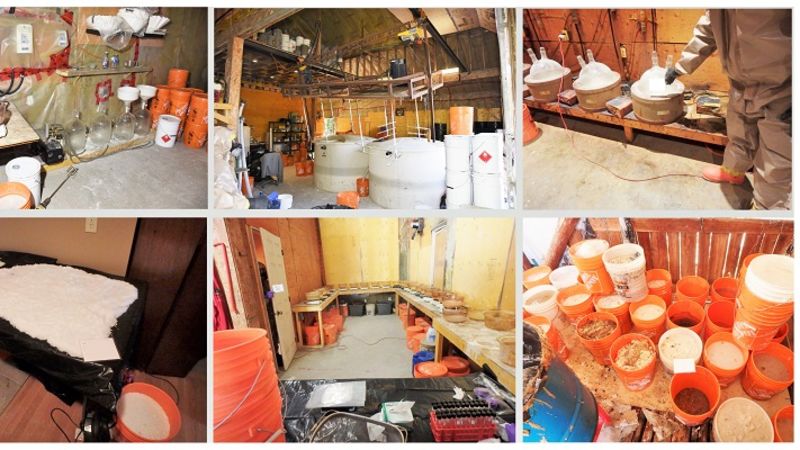
Image: BC RCMP Federal Serious & Organized Crime / A BC RCMP federal policing investigation that resulted in the dismantling of one of the largest drug super-labs in BC, and conviction of all 6 suspects, has culminated with the last 2 suspects being sentenced to 11 years of imprisonment for their involvement in the production of methamphetamine, and fentanyl. A total of $258 million in drugs were seized by federal authorities. 
BC RCMP drug super-lab investigation

BC RCMP wraps up massive drug lab case that saw 6 convictions, drug seizures of $258 million

Sep 12, 2023 | 8:36 AM

SURREY — A BC RCMP federal policing investigation that resulted in the dismantling of one of the largest drug super-labs in BC, and conviction of all 6 suspects, has culminated with the last 2 suspects being sentenced to 11 years of imprisonment for their involvement in the production of methamphetamine, and fentanyl.

In a news release from the BC RCMP Tuesday morning, Mounties announced that on August 14, 2023, Robyn Leigh Bryson, 38, and Trent Anton Fussi, 33, were each sentenced to concurrently serve a total of 11 years in prison, for the production of fentanyl, and 6 years of imprisonment for the production of methamphetamine. Bryson and Fussi were convicted on two counts of Production of a Controlled Substance contrary to section 7(1) Controlled Drugs and Substances Act (CDSA), after being identified as the cooks at the industrial-scale methamphetamine and fentanyl drug lab, which was located in Lumby, BC. Bryson and Fussi also received a 10-year firearm prohibition, and DNA orders.

The investigation into this criminal network was first launched by the BC RCMP Federal Serious and Organized Crime (FSOC) program in 2018; and given the scale, complexity, and hazardous nature posed by the clandestine drug lab, a number of other specialized BC RCMP Federal Policing units were deployed to assist. With the FSOC Border Integrity unit taking the lead, the investigative units included the FSOC Osoyoos team, FSOC Kelowna team, BC RCMP Federal Policing – Clandestine Laboratories Enforcement and Response team (CLEAR), Federal Operations Major Projects team, as well as a number of other RCMP units, and partner agencies.

During the initial stages of the investigation that included the execution of several search warrants, Federal Policing investigators uncovered a large-scale ephedrine extraction, as well as a methamphetamine and fentanyl production lab. The main suspects involved in the criminal operation were also identified as Michael McMorris, Trent Fussi, Tyson Kopp, Michael Piggott, Michael Harvey, and Robyn Bryson.

In order to prevent further production, and distribution of millions of doses of potentially lethal drugs into communities, and to mitigate the significant environmental and safety concerns posed by the synthetic chemicals at the lab, BC RCMP FSOC took immediate enforcement action by executing a search warrant on the property, and arrested Trent Fussi, Tyson Kopp, Michael Piggott, Michael Harvey, and later, Robyn Bryson. The CDSA search, conducted on October 18, 2018, yielded approximately 48 kilograms of ephedrine HCl, 50 kilograms of solutions containing ephedrine HCl, 4.5 kilograms of methamphetamine HCl, 147 gallons (556 litres) of solutions containing methamphetamine, 10 kilograms of 4-anilino-N-phenethylpiperidine (ANPP), 2.95 kilograms of nandrolone phenylpropionate (NPP), 660 grams of fentanyl and 124.7 litres of solutions containing both fentanyl and ANPP.

Since the vast sum of synthetic waste material found on the property posed a significant health and safety risk to local residents, the environment, and regional agriculture, major containment and cleanup efforts ensued. The search and dismantling of the massive drug super-lab took BC RCMP FSOC investigators a total of 12 days to complete, with the cost of the cleanup, and disposal of the hazardous waste material totalling nearly $370,000.

During sentencing, the court heard that the street value of the seized methamphetamine was estimated at $2.2 million, and the street value of the fentanyl, once cut and mixed, would amount to an estimated $256 million, according to Corporal Arash Syed, media relations spokesperson for the Surrey-based Federal Serious & Organized Crime unit.

Since 2022, the ever-increasing number of unregulated drug related deaths have risen across BC, equating to 6.1 deaths per day in June 2023, and increasing to 6.4 deaths per day in July 2023. Furthermore, a disturbing trend was also observed for the first time in 2022, where unregulated drug related deaths became the leading cause of death for most age groups across BC. According to the BC Centre for Disease Control, in 2022, the consumption of unregulated drugs became the leading cause of death among BC youth between the ages of 10 to 18, as well adults between the ages of 19 to 59. Therefore, toxic-drug-related deaths have replaced accidents, as the previous years’ leading cause of death for youth, while overtaking cancer as the main cause of death for middle-aged adults in BC.

The sharp rise in illicit fentanyl related deaths are in large part attributed to the fact that many other types of illicit drugs are intentionally, or in some cases, inadvertently being mixed with toxic fentanyl. It is believed that the vast majority of youth who end up consuming lethal doses of fentanyl are actually not seeking heroin, and fentanyl; instead, they are seeking other black-market prescription opioids such as Vicodin, OxyContin, Percocet, hydrocodone, and benzodiazepines. However, since much of the illicit drug supply is contaminated by fentanyl, many unsuspecting illicit drug users are falling victim to polysubstance poisoning from other drugs that are laced with fentanyl. Fentanyl is also increasingly detected in stimulant drugs such as cocaine and methamphetamine, as well as in sedatives such as benzodiazepines, which greatly complicates the effectiveness of opioid-centric interventions. According to a publication by the Government of British Columbia on drug awareness, any illegal drugs such as heroin, cocaine, ecstasy, meth or crack, can contain a lethal amount of fentanyl.

Based on insights gleaned from this, and other BC RCMP Federal Policing investigations, it is evident that clandestine facilities that produce illicit fentanyl, are often involved in the production of other forms of unregulated drugs, by using the same fentanyl-contaminated equipment; therefore, significantly increasing the likelihood of mixing the drugs into potentially lethal polysubstances. This trend is supported by a recent report by the government of Canada, which states that of the accidental apparent stimulant toxicity deaths in 2022, 78 per cent involved an opioid, and, of the accidental stimulant toxicity deaths in 2022, 64 per cent involved cocaine, while 53 per cent involved methamphetamine.