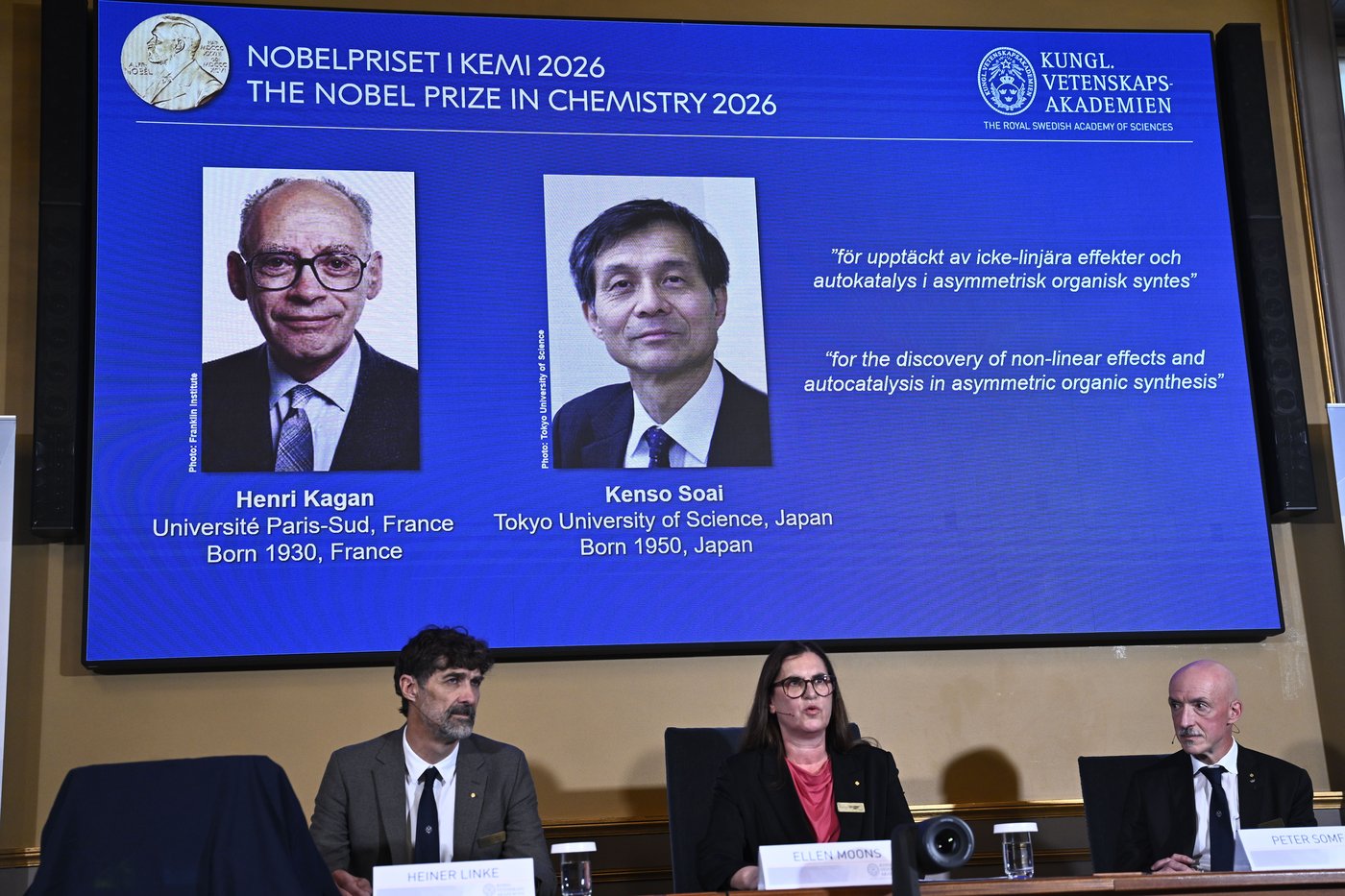
Portraits of Henri Kagan and Kenso Soai are shown on the screen as they are awarded the 2026 Nobel Prize in Chemistry, at the Royal Swedish Academy of Sciences in Stockholm, Sweden, on Oct. 7, 2026. Photo: (Fredrik Sandberg/TT News Agency via AP)

Scientists win chemistry Nobel for discoveries about mirrored molecules that led to many drugs

Oct 7, 2026 | 3:04 AM

STOCKHOLM (AP) — Scientists Henri B. Kagan and Kenso Soai won the Nobel Prize in chemistry Wednesday for untangling mysterious mirror images in molecules, a discovery that has been used to develop countless drugs and transformed modern medicine.

Many molecules come in versions that look alike but are not exactly identical, like right and left hands. Kagan, who is from France, and Soai, from Japan, found ways to make chemistry pick a side, describing and designing reactions to produce the desired mirror image.

“The medicines we have today would not be possible without this chemistry,” said Rigoberto Hernandez, president of the American Chemical Society.

Soai was shopping at a neighborhood supermarket when he heard he had won.

“I’m very excited to receive the very nice news,” Soai told the Nobel committee and journalists by phone. “Of course, this is one of the most exciting days in my life.”

The discovery enabled most modern medicines

Mirror images of the same molecule can have different properties. For example, one version of the chemical carvone smells like mint, while the other has a whiff of caraway, a spice often used in rye bread.

The alternate versions can also behave differently when interacting with other chemicals. When designing drugs to treat diseases, scientists are choosy about which mirror image they use. They want the version of a molecule to treat a cold, not one that will make the sniffles worse.

In the 1980s, Kagan’s work showed there might be a way to design reactions to produce one form of a molecule over the other. Years later, Soai perfected the process. He created the first-ever chemical reaction to efficiently produce only one of a molecule’s mirror images, in what’s now known as the Soai reaction.

“This is probably the coolest experiment in organic chemistry,” said Peter Somfai, a member of the Nobel Committee for Chemistry.

Kagan, 95, is affiliated with the Université Paris-Sud in Orsay, France. Soai, 76, is affiliated with the Tokyo University of Science. The Nobel committee described their work as a feat never previously achieved by anyone “other than life itself.”

The French Academy of Sciences, where Kagan is a member, congratulated him, as did French President Emmanuel Macron, who called the prize “an immense source of pride for the country” and “a recognition befitting a lifetime of research.”

“It might be difficult to say that this drug, or that drug, was developed using this,” Somfai said. “I would say all of them, because we use this as a tool, we use this as an understanding, how to develop catalysts, how they function.”

Life, too, prefers one mirror image over the other. DNA twists to the right, and the proteins in human bodies are made of mostly left-handed building blocks.

In addition to developing better medicines or perfumes, deciphering the mirror images of molecules can help scientists understand the chemical architecture of life, said chemist Holden Thorp, editor-in-chief of the journal Science.

“There are still fascinating aspects that remain unknown and surely more yet to be discovered,” Soai said at a news conference hosted by his university in Tokyo. “I hope to do what I can, however modestly, to contribute to help advance research in this field.”

Japan’s largest newspaper, Yomiuri, distributed an extra edition with a headline proclaiming “Nobel Prize Mr. Soai,” with a big photo of the scientist. The papers quickly disappeared as office workers picked them up on their way home.

More Nobel prizes are still to be awarded

The Royal Swedish Academy of Sciences announced the winner in Stockholm.

Last year, three scientists won the chemistry Nobel for their development of new molecular structures that can trap vast quantities of gas inside, laying the groundwork to potentially suck greenhouse gases out of the atmosphere or harvest moisture from desert environments.

This year’s prizes began with the Nobel for medicine, awarded Monday to three scientists whose work led to a tool that uses light to help unravel how the brain works. The physics award announced Tuesday recognized a scientist’s efforts to demystify a rare group of neutrinos.

The literature prize is set to be awarded Thursday. After Friday’s peace prize is awarded, the Nobel Memorial Prize in Economic Sciences will be announced Monday.

The prize money this year is 12 million Swedish kronor (about $1.2 million), whether for an individual, a small group of laureates or an organization.

___

This story has been corrected to correct that Kagan, not Soai, is 95.

___

Ramakrishnan reported from New York. Dazio reported from Berlin. Associated Press journalists Alexa St. John in Detroit, Catherine Gaschka in Paris and Mari Yamaguchi in Tokyo contributed to this report.

___

AP Nobel Prizes: https://apnews.com/hub/nobel-prizes

Adithi Ramakrishnan, Kostya Manenkov And Stefanie Dazio, The Associated Press