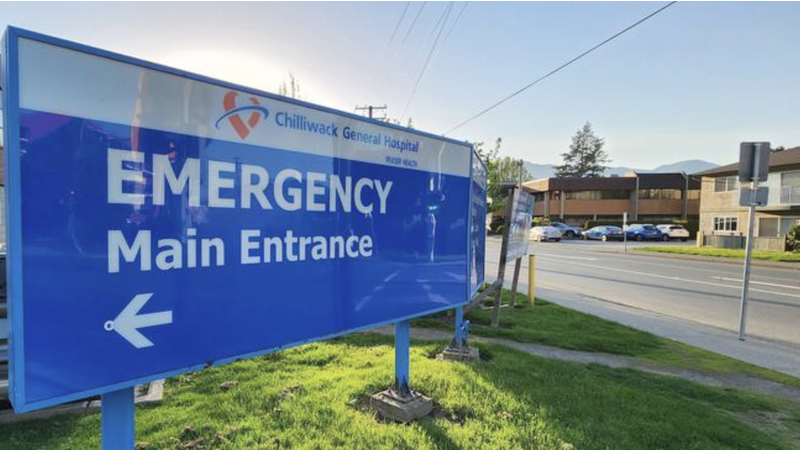
Image: Mike Vanden Bosch / Pattison Media / While there might be land committed for the eventual construction of a long-term care facility in Chilliwack near Chilliwack General Hospital, the project still needs approval from the provincial government.
Long-term care project in Chilliwack

Funding committed for long-term care project in Chilliwack, but province has yet to approve it

Mar 7, 2024 | 1:02 PM

CHILLIWACK — While there might be land committed for the eventual construction of a long-term care project in Chilliwack, the project still needs approval from the provincial government.

According to a staff report dated February 29, 2024 that was brought forward to last week’s meeting of the Fraser Valley Regional Hospital District Board, FVRD Chief Administrative Officer Jennifer Kinneman included a comment in the staff report that says funding has been committed to a future Chilliwack long-term care project. However, as Kinneman pointed out, this project has not yet received approval from the provincial government, and the actual start date is unknown.

Back in November 2023, Fraser Valley Today reported that Fraser Health had acquired several properties near Chilliwack General Hospital, with support from the B.C. Ministry of Health, towards the eventual construction of a new long-term care facility in Chilliwack.

According to a statement from Fraser Health public affairs spokesperson Nick Eagland back on Tuesday, Oct. 31, 2023, Fraser Health had been working on a business plan to construct a long-term care facility to ensure the health authority can meet the growing need in the Chilliwack community for this level of care for years to come.

“We expect to submit our business plan to the Ministry of Health in early 2024,” Eagland pointed out. “The plan will include the expected cost of the project and anticipated timeline for completion.”

Eagland said that in September 2023, with the support of the Ministry of Health, Fraser Health acquired multiple properties near Chilliwack General Hospital for this project.

According to documents on the B.C. Bid government website, the properties in question consist of 8996, 9006, 9020, 9030 and 9040 Mary Street, and 8979, 8999, 9015 and 9049 School Street.

It should be noted that some of these addresses on Mary Street and School Street are abandoned homes, including some that previously had had blue fencing around them. One of the addresses in question, 9049 School Street, was the site of a suspicious fire in October 2023 that attracted 30 firefighters from the Chilliwack Fire Department. The home at 9049 School Street was subsequently torn down and demolished following the fire.

The combined area of the nine lots is approximately 7,669.5m² (~1.9 acres).

Further, as per information on the B.C. Bid government website, the exact verbiage of the project stated: “Fraser Health is partnering with the Fraser Valley Regional Hospital District (FVRHD) to build a new two hundred (200) bed long-term care home with up to thirty two (32) client Day Program for Older Adults (DPOA) to replace the ninety (90) bed Bradley Centre which is currently located at the Chilliwack Hospital in Chilliwack, BC. The proposed Project site is currently a developed/brownfield site located in Chilliwack, B.C.”

Bid documents say the project will include support services areas for food services, housekeeping, linen and laundry services, and equipment washing. Common areas include dining rooms, activity areas for programs, staff offices and support areas, outdoor space, and gardens. There are also transportation interfaces such as loading facilities, underground parking for staff, visitors, and oversized parking stalls for ambulances and HandyDART.

The project will have a total building gross area of about 16,802m². The design is based on a small household model comprised of one 13-resident household and one 12- resident household paired together to create one 25-resident neighbourhood. There will be a total of eight (8) neighbourhoods (i.e., 16 households) in the building. Each household is substantively self-sufficient in terms of support space, with minimal support space shared between households, increasing care efficiency and when required, pandemic and infection control resiliency. Each floor also provides floor-shared shared clinical support spaces outside of the household pairs.