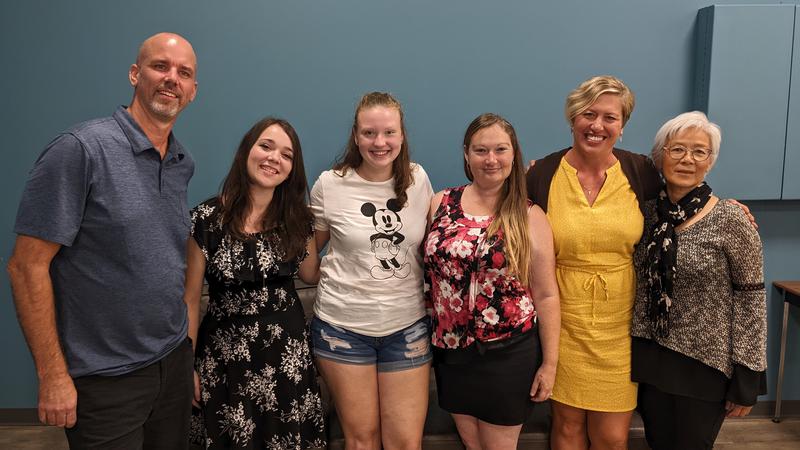
Image: Supplied by CRJ / Chilliwack Restorative Justice collectively strive to repair harm and establish a culture of restoration and reconciliation in local schools and communities. Staff include Steve Roukema (left), Danielle Otermat, Alexis Stollings, Lisa Sperling, Haley Berger, and Rose Yan.
Restorative Justice

Chilliwack Restorative Justice grows to provide a service that addresses harm caused by crime or conflict

Nov 22, 2022 | 11:27 AM

CHILLIWACK — As a non-profit agency in the second-fastest growing city in Canada between 2016 and 2021, Chilliwack Restorative Justice exists to establish a culture of restoration and reconciliation in local schools and communities.

Chilliwack Restorative Justice (CRJ) first launched in June 1998 and has expanded with a growing municipality. Over the past fiscal year, CRJ worked with 65 clients, of which an impressive 95 per cent were successful.

In September, the registered Canadian charity received 10 new referrals in its Restorative Response program, which is bolstered by 28 active volunteers. It has 74 volunteers in its Operation Red Nose Community Restorative program, and another two volunteers in its School Restorative program.

The work of CRJ does wonders to transform Chilliwack, as the non-profit engages with the broader community to repair and prevent harm through restorative forums and interactive teaching, thanks to trained community members who furnish alternatives to the court system through restorative circles.

“We engage with the community to repair and prevent harm and conflict through restorative circles and interactive teaching,” its website states. “We build safer environments through Community Accountability Panels and Victim-Offender Conferencing.”

Its six staff consist of an executive director, a restorative response coordinator, a restorative school coordinator, a restorative community coordinator, and two classroom facilitators.

“The most gratifying part of my job is when a person responsible (offender) recognizes that the restorative justice process is an opportunity to reset their lives and do better with the resources available to them,” said Executive Director Steve Roukema.

Here’s how the restorative justice process unfolds. CRJ engages with the community to repair and prevent harm and conflict through restorative circles and interactive teaching, Roukema explained.

“Most of our cases are pre-charge and referred by police, loss prevention officer (i.e., security guard from Superstore or other large store), Department of Fisheries and Oceans, or a school,” Roukema says. “When the police catch someone committing an offence, they have a few options; one of them is to refer to Restorative Justice.”

The next step can involve a formal acknowledgement by the offender that they are taking responsibility for the offence and choosing to be part of the restorative justice process.

“When the Person Responsible (Offender) and Person Harmed (Victim) voluntarily participate and sign the necessary documents, our restorative response coordinator receives the forms from the police and begins the intake calls to set up the restorative circle within 35 days,” Roukema says.

There are 3 meetings that subsequently happen with the volunteers that facilitate the restorative circle within 35 days, including:

* Pre-conference meeting with the person responsible and their support people

* Pre-conference meeting with the person harmed and their support people

* Restorative Circle with all restorative justice volunteers, including a facilitator, co-facilitator, and mentor, as well as the person responsible and their support people, the person harmed and their support people. The mentor keeps in contact with the person responsible after the restorative circle to ensure they receive the support necessary to complete the resolution agreement.

Roukema foresees a robust future in which CRJ expands its school presence and volunteer base.

“Over the next year and beyond I hope for Restorative Justice to be active in 50 per cent of the schools in Chilliwack, receiving 90 referrals, 35 trained volunteers, a full-time Restorative Response Coordinator, a full-time Restorative Community Coordinator, through increased awareness through the Upper Fraser Valley, with the potential for new partnerships to form in the community that deal with negative behaviour to prevent the criminal patterns,” Roukema said.