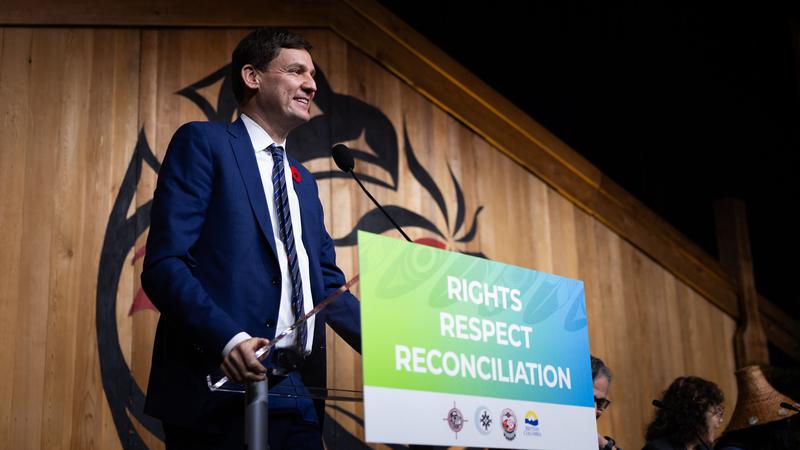
Image: B.C. Premier David Eby speaks at the 10th B.C. Cabinet and First Nations Leaders’ Gathering in November in Vancouver. / BC Govt. / Flickr
OPINION

YOUR PERSPECTIVE: The path forward in B.C. is together or not at all

Jan 13, 2026 | 2:16 PM

At this time last year, we were fighting external economic threats from the U.S. and now some would rather we turn on each other.

Building projects in partnership with First Nations means jobs and prosperity for the entire province. We simply can’t afford to walk away from co-operation with First Nations and choose, instead, to fight.

Reconciliation isn’t new, and it isn’t radical. It reflects a broad consensus in this province that working in partnership with First Nations is better than endless conflict. That’s why the Declaration on the Rights of Indigenous Peoples Act passed unanimously in the legislature.

That consensus has been strained by recent court decisions that have created confusion about what reconciliation means in practice. Today, many people are feeling worried about how it could affect their families, their homes and their businesses. Now, critics say we must undo all the work of DRIPA to move forward. But, along with abandoning our responsibility to address the harms of the past, that would be a massive economic mistake.

When governments walk away from agreements with First Nations, projects don’t move faster — they stop. Construction sites go quiet. Permits are delayed. Investment dries up. Workers receive layoff notices instead of paycheques. Communities lose the revenue needed to build schools, hospitals and homes.

Ripping up the act or ending talks with First Nations, as the B.C. Conservatives have recklessly suggested, wouldn’t protect homeowners or small businesses. It would guarantee years of court battles, stalled projects and uncertainty hanging over entire regions of the province.

The concept of First Nations title, which underlies the issues of land use and consent, wasn’t invented by the act. It’s part of Canada’s Constitution and has existed since before Confederation. Repealing DRIPA wouldn’t make title claims, like the one involving the Cowichan, go away. Repealing DRIPA would return us to a dark time and set us back a generation in our relationship with First Nations.

By contrast, when projects are done in partnership with First Nations, they get built. Workers get hired. Local businesses win contracts. Revenue flows back into communities. That stability is why B.C. is positioned to secure close to $100 billion in major private sector investment, creating good, family supporting jobs across the province.

As First Nations leaders have pointed out, every major project in the province would be in jeopardy if we repealed DRIPA. Billions in mining and clean energy projects are being moved forward in partnership with First Nations. Partnerships with First Nations are making B.C. an international energy superpower — with billions in investments in the LNG sector

British Columbians expect their government to protect what they have worked for, reduce confusion and provide stability — not allow fear to be amplified or used for political gain.

So let us be clear about what this is, and what it isn’t.

Reconciliation isn’t about taking away anyone’s home. It isn’t about undermining private property. And it isn’t about handing decisions over to judges. At its core, this work is about making sure everyone who calls B.C. home has the same chance to build a good life, with stable jobs, secure housing and strong public services.

Private property rights are a line in the sand for our government. British Columbians have worked their whole lives to buy their homes and build their businesses. Those homes represent life savings, retirement security and something to pass on to the next generation. We will protect private property rights.

That is why we’re appealing the Cowichan decision and will be bringing forward legislative amendments to provide clarity in light of recent rulings from the courts. Decisions about reconciliation must be made by British Columbians, through our legislature and through agreements, not by courts issuing unpredictable rulings that leave people anxious about their future.

Turning reconciliation into a wedge issue might generate headlines, but it would come at the expense of progress.

British Columbians believe in fairness and hard work. If we fix what needs fixing instead of tearing everything down, we can build something stronger.

We all want to build the B.C. of our dreams. To get there, the path forward is together — or not at all.

——

Editor’s Note: This opinion piece reflects the views of its author, and does not necessarily represent the views of Fraser Valley Today or Pattison Media.