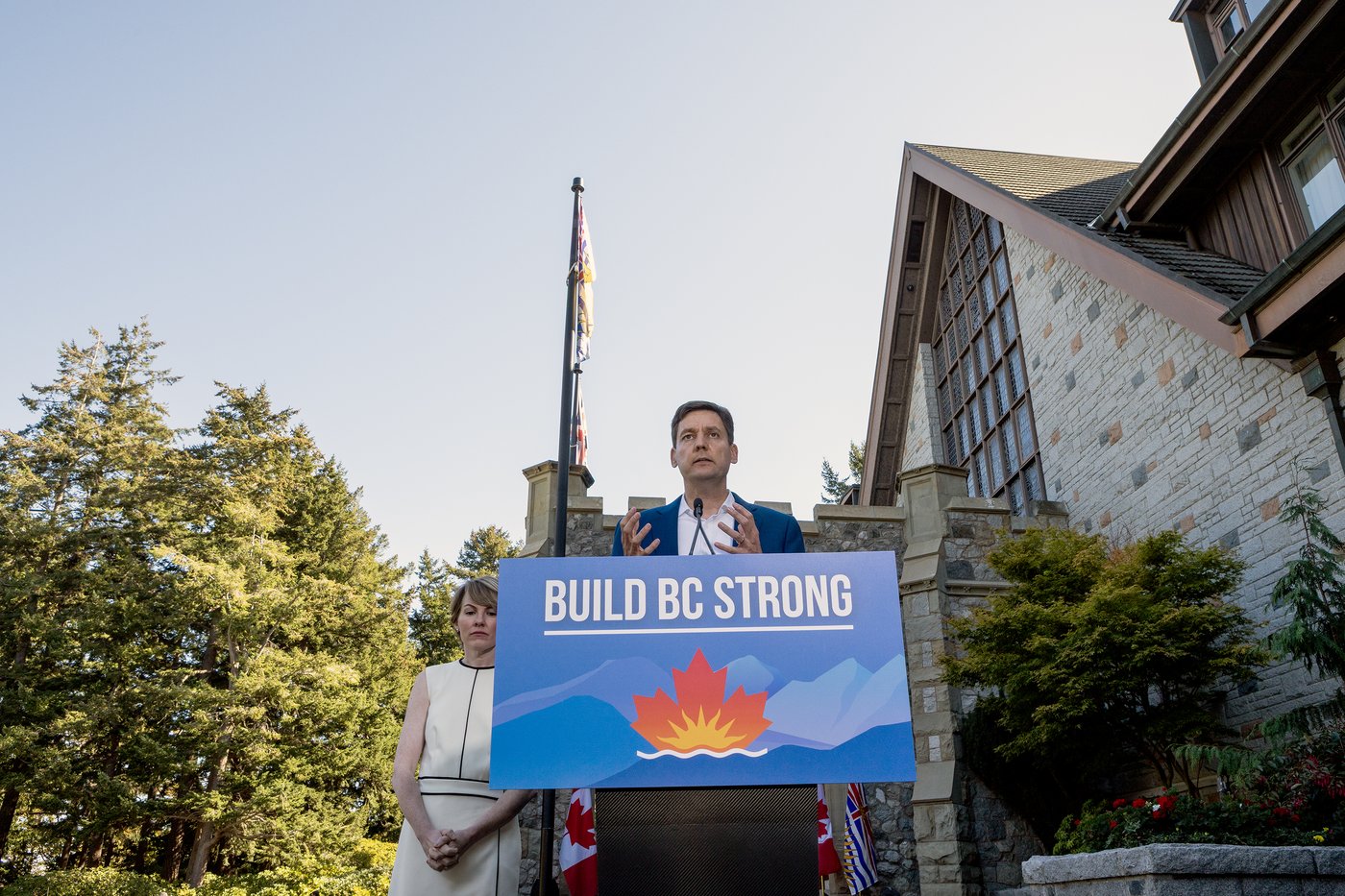
Premier David Eby is joined by his wife Dr. Cailey Lynch as he announces a snap election during a press conference at Government House in Victoria, on Tuesday, Sept. 22, 2026. THE CANADIAN PRESS/Chad Hipolito

B.C. opposition forces unite as Eby calls Oct. 24 snap election, citing Trump threat

Sep 22, 2026 | 12:19 PM

VICTORIA — British Columbia’s political scene is undergoing breakneck restructuring ahead of an Oct. 24 snap election that NDP Leader David Eby called on Tuesday, framing it as necessary to respond to the threat posed by U.S. President Donald Trump and his trade war.

Eby, who called it an “existential moment” for the province, had gone to Government House to ask Lt.-Gov. Wendy Cocchia to dissolve the legislature while expecting to face opponents splintered into two main factions — the official Opposition B.C. Conservatives and CentreBC, with eight legislators.

But less than two hours after Eby emerged, his opponents had forged a deal to unite, with seven legislators from CentreBC rejoining the Conservative caucus.

It had also been unclear at the start of the day exactly who was the alternative contender to become premier, but interim Conservative leader Lorne Doerkson later made clear that he was in it to win it.

Eby mentioned Trump more than 20 times outside Government House, as he called for a firebreak against both the trade war and “Trump-style politics.”

“When you smell smoke you don’t sit and wait to see what happens next,” he said.

He did not mention Doerkson in his speech.

But Doerkson, who returned from an African vacation on the weekend to be drafted as the Opposition leader after the resignation of Kerry-Lynne Findlay, has moved swiftly to reunite the opposition.

In two days, he brought back a dozen or so legislators who had quit or been expelled from caucus by Findlay during her brief and troubled reign.

Doerkson, a former newspaper publisher, said Tuesday he was seeking to be more than an interim premier, while acknowledging the unlikeliness of his rise from political obscurity in the riding of Cariboo-Chilcotin to centre stage.

“You know, this was a bit of a surprise to myself as well,” he said at Crab Park in Vancouver, flanked by caucus members and former candidates for the Conservative leadership race that Findlay won in May.

“And so, my feeling at this point is that I’m running for premier right now … And so, when we take that office, I will continue to serve as premier.”

The official Opposition’s constitution prohibits an interim leader from seeking the position permanently. Doerkson did not explain how he would get around that rule.

“There’s no question that our caucus is a pretty lively caucus,” he said in response to a question about recent division in the ranks. “But we are back together here today and we are going to take on David Eby.”

Doerkson also sought to distance the Opposition from Trump, calling him “the bully south of the border” as he addressed reporters

He said the election call was a cheap, opportunistic political move that would cost millions of dollars.

“But you know what, I think David Eby is going to regret this. And it’s because it actually offers an opportunity for hope and real change,” he said.

CentreBC’s short-lived leader Peter Milobar, who held that role for less than five days before rejoining the Conservatives, stood with Doerkson. Milobar defined the Conservatives as a “progressive-ideas and conservative-values party.”

Eleanor Sturko said she was the sole CentreBC member who would not rejoin the Conservatives, and CentreBC later said in a statement that she had been appointed leader.

‘It’s a valued-based decision,” she said. “They (CentreBC) have a vision and philosophy I can support.”

Not everyone is happy with the rapid reshaping of the Conservative ranks since Findlay’s exit — her husband, legislator Brent Chapman, announced on Tuesday that he was leaving the Conservatives to join right-leaning OneBC.

And Doerkson later said that Findlay had left the party and would not be its candidate in Abbotsford-Mission, where she had been poised to stand in a byelection that was cancelled when the general election writ dropped.

While the Conservatives had recently spent weeks shedding legislators who blamed Findlay’s leadership or ideological differences as the party swung further to the right, it is Eby who is now suffering political losses, with three cabinet ministers saying they would not run on Oct. 24.

British Columbia Health Minister Ravi Kahlon said Tuesday that the time was right for him to step aside in Delta North after three election cycles, while Emergency Management Minister Kelly Greene cited her ongoing opposition to the NDP-backed Tilbury LNG expansion project for her decision not to stand.

Tourism Minister Lana Popham said Monday that she would not be running for a sixth term after 17 years in elected office.

Nevertheless, Eby, who has a one-seat majority, said there had not been a moment since the 2024 election when the Conservatives were not in chaos.

He accused the party of going easy on Trump, who he accused of “targeting our businesses and he is threatening our sovereignty.”

“At a time when Trump is creating more uncertainty, the last thing we need to do is abandon the front line. That’s what the Conservative parties want to do. They want to fan the flames, at the worst possible time,” he said.

The date of final vote is a week after municipal elections are scheduled, and Eby called the vote despite pleas not to do so from numerous local government leaders.

Eby has recently looked politically vulnerable after several attempts to amend the Declaration on the Rights of Indigenous Peoples had failed, even though he had tried to discipline his caucus through the threat of an early election.

His government has also been beset by financial woes, and B.C. Finance Minister Josie Osborne announced last week that the deficit forecast had grown by $450 million to a record-setting $13.8 billion, largely because of a “calculation error” in the budget on natural gas royalties.

But recent disarray in Conservative ranks appears to have influenced the election call, with the NDP caucus meeting on Sunday to discuss Findlay’s exit and election plans.

BC Green Party leader Emily Lowan said in a statement that the snap election is costly and isn’t wanted.

“This government has offered tough talk on Trump but hasn’t delivered any real support for the people and industries feeling the pain, or implemented plans to build a local, resilient economy that could actually withstand the next shock,” she said.

Incumbent Vancouver mayoral candidate Ken Sim also criticized Eby for launching a provincial election campaign when municipalities were already in the middle of local campaigning for an Oct. 17 vote.

“British Columbia has separate election cycles for a reason. That principle shouldn’t be set aside because the timing looks politically convenient,” Sim said in a statement.

Elections BC said advance voting would be available from Oct. 16 to Oct. 21.

This report by The Canadian Press was first published Sept. 22, 2026.

— With files from Brenna Owen in Vancouver

Wolfgang Depner, The Canadian Press