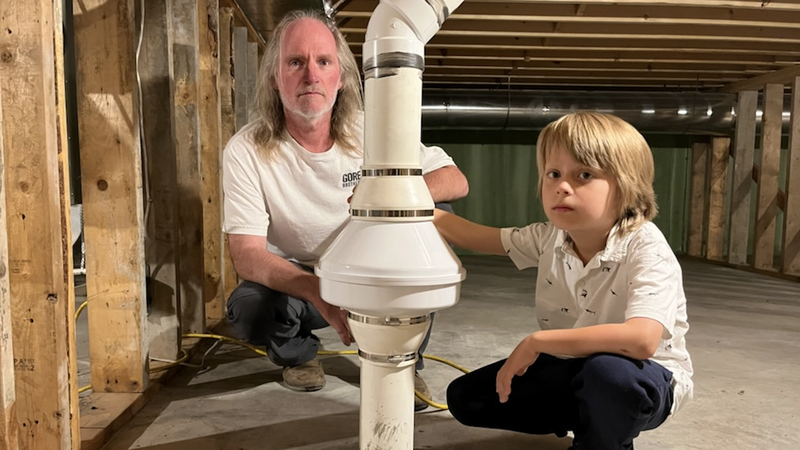
Image: Supplied / Chilliwack resident Mark Gore is pictured with his son, Jack, next to a radon fan that was installed in his home. Gore said his home originally had radon levels of 1000 bq/m3, which are significantly higher than the threshold set by Health Canada. With mitigation measures in place, including this radon fan, Gore said he now has levels less than 20 becquerels per cubic metre and is happy he tested the radon levels in his home for his son Jack's sake. 
Radon exposure in Chilliwack homes

Radon exposure in Chilliwack homes a growing concern

Jun 19, 2023 | 10:04 AM

CHILLIWACK — The concept of radon exposure may not seem like a clear and present danger to the typical homeowner or residential tenant in Chilliwack.

But when Chilliwack resident Mark Gore learned that his home registered radon levels five times higher than the current Canadian guideline of 200 becquerels per cubic metre, he wasn’t thinking first and foremost about the cost associated with radon mitigation.

He was thinking more about his son Jack’s long-term health.

“My home originally had radon levels of 1000 bq/m3,” Gore said. “With mitigation levels, we now have levels less than 20 becquerels per cubic metre. For my son Jack’s sake, we are happy we tested our home.”

Mark and his son Jack were pictured for this story next to a radon fan that was installed.

“Radon is pulled from under the slab and evacuated to the exterior of the home,” Gore said. “It’s an easy fix and highly efficient.”

According to Health Canada, radon is a naturally occurring radioactive gas that is formed by the breakdown of uranium in soil, rock and water. The Canadian Lung Association says radon is the second leading cause of lung cancer in Canada; radon exposure is estimated to be the cause of 16 per cent of lung cancers.

Mark’s sister, Jill Hall, has been alerting public authorities about the need to mitigate radon exposure. Jill and her brother Tony Gore, both Chilliwack residents, started testing for radon here in town about two years ago and discovered some alarming results.

“We found readings peaking up to 1000 bq/m3 in homes in Chilliwack,” said Tony Gore. “This is 10 times over World Health Organization levels of 100 bq/m3. In the past two years we have tested over 100 homes with 30 per cent having high radioactive gas levels.”

During a recent public information and testing campaign commissioned by the City of Chilliwack, nearly five per cent of Chilliwack homes tested had high radon levels above the 200 becquerels per cubic metre.

“That equates to thousands of homes potentially in our area with radioactive gas levels of concern,” Hall said.

A similar initiative undertaken by Cultus Lake recently found that 22 per cent of homes there had radon levels above 200 becquerels per cubic metre, Hall reported.

“Residents should test in winter months for accurate readings,” Hall said. “Mitigation is simple and highly effective. A digital radon monitor provides a good visual reading 24/7 and allows homeowners to be able to monitor the safety of their indoor air quality at all times. Children’s and pets’ lungs are the most vulnerable to this highly carcinogenic radioactive gas. Lung cancer is on the rise, being the cancer with the highest incidence of all cancers.”

When it comes to simple and easy fixes to address radon exposure, Hall says a pipe with an attached fans draws radon from below a house’s foundation and evacuates radon outside of the home by not allowing it an ingress.

Hall, a realtor by trade and a retired RN, says she has sent over 1,200 emails the past two years in an effort to address the spread of the radioactive gas.

“I’d like to know who is responsible for raising the alarm to all our citizens who are living in existing homes, and breathing in this highly carcinogenic radioactive gas?” Hall said. “Who is responsible for this significant misstep being contrary to the hypothesis that if we don’t test we don’t have radon in all our homes, schools, universities, hospitals and workplaces. According to Health Canada, radon is present in all indoor environments and at levels that will cause great harm. The only way to know your level of exposure to radon is to test.”

Hall says Health Canada has been testing all federally-owned buildings, including prisons, for years. However, Hall says schools, daycares, hospitals and workplaces are not tested for radon.

“Health Canada has failed our citizens throughout Canada,” said Hall, who has emailed provincial and federal health officials along with local health authorities. “This is a worldwide public health issue and Health Canada unfortunately gets a strong F- on educating and protecting our citizens from this highly carcinogenic gas known as radon, a known latent defect.”