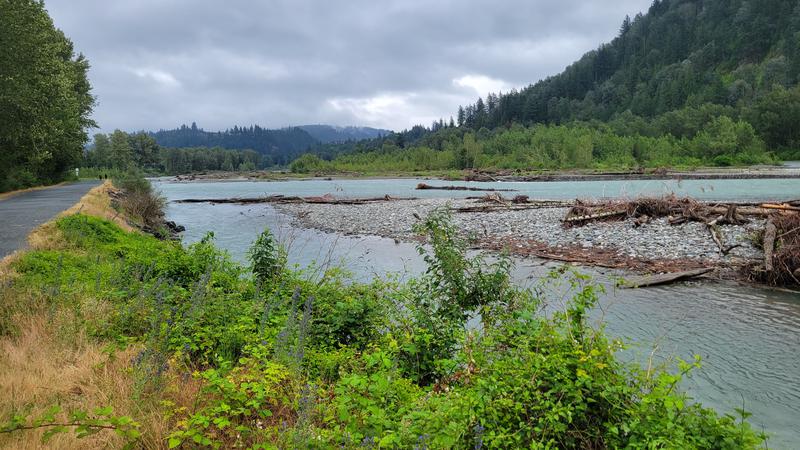
Image: M. Vanden Bosch / PML / The Vedder River is shown. Chilliwack City Council awarded a contract to Jake's Construction for up to $500,000 to remove sediment from the Vedder River and Canal for flood protection purposes.
Flood protection

City awards $500,000 contract to Jake’s Construction to remove sediment from Vedder River for flood protection purposes; City seeks to reduce impact to pink salmon

Jul 23, 2022 | 5:38 AM

CHILLIWACK — In a normal year, less than 40,000 cubic metres of debris and gravel are typically deposited into the Vedder River and Canal.

The atmospheric river events of November 2021 unleashed nearly 11 times that amount of sediment into the Vedder River and Vedder Canal in seemingly record fashion.

For flood protection purposes and to address an unexpected 440,000 cubic metres of debris that fell into the Vedder River and related waterways, Chilliwack City Council voted on Jul. 19 to award a contract of up to $500,000 to Jake’s Construction Ltd. for sediment removal.

Sediment removals occur every two years, according to a staff report by Frank Van Nynatten, assistant manager of environmental services for the City of Chilliwack. They’re done in such a way so as to reduce impacts to pink salmon under the supervision of environmental monitors.

The city needs to obtain approval from Fisheries and Oceans Canada and through the B.C. Water Sustainability Act. Assuming the necessary authorizations are obtained federally and provincially, work should last from August 1 until September 15.

The Vedder River Management Area Committee plans and designs all sediment removals from the Vedder River and Canal in order to maintain floodwater capacity. Without this critical management oversight, naturally deposited, naturally occurring sediment would lead to increased floodwater risks and diminish the effectiveness of the dike system.

Eleven sediment removal sites have been identified, including five provincial crown locations, five in Chilliwack, and one in Abbotsford.

The five provincial locations are Geisbrecht, Peach, Lickman, Campground, and Railway Bars. The five Chilliwack sites are Railway DS, Yarrow, Greendale, Salad, and Powerline Bars. The lone Abbotsford location is Boundary Bar.

During Tuesday’s meeting, Councillor Jason Lum asked about a couple removal sites that may require deferral due to inaccessibility. For example, there are capacity issues with the bridge at the Blue Heron Reserve, while the city prefers not to encroach upon protected habitat along the Vedder Rotary trail.

“I’m just wondering if those sites are deferred, is it something we have to go back to the drawing board and get approval again while we continue the program?” Lum pondered.

Van Nynatten indicated the city will conduct its survey of sediment deposits again in 2024. “It’s our intention to do removals every two years,” he said. “We hope to get approvals to remove up to the long-term average which, at this point, it’s about 55,000 cubic metres of sediment per year. We would be putting in another application to remove another 110,000 in 2024. Hopefully we’ll get the ability to access those sites at that time. We really have to be able to get beyond those pedestrian bridges and beyond the trail. These two sites [Blue Heron Reserve and Rotary trail] don’t lend themselves to that.”

Councillor Chris Kloot asked how confident city staff were in securing disaster financial assistance (DFA) funding. He expressed surprise at just how big a contract sat before them.

“From all the years I’ve sat at this table, we’ve never really had to foot a bill this large because the awarded person who wins this [contract] tends to make money on it,” Kloot said, referring to contractors who are able to collect the gravel and sediment and then resell it.

Nynatten said the city hopes to recoup some of its costs from some level of government.

“There’s always some risk,” Van Nynatten told Councillor Kloot. “We don’t know for certain if we’re going to get DFA funding. We’re hopeful. Certainly the province and Ministry of Environment and Fisheries [and Oceans], they all appreciate and understand there was a big slug of sediment that came down there. They’re all supportive of removing it. So, hopefully DFA will reflect that.”