Credit: M. Vanden Bosch
Residential Schools

Solidarity Run revisits heartbreaking legacy of residential schools

Jun 21, 2022 | 12:32 PM

CHILLIWACK – Juanita Soles was reluctant to revisit the site that haunted her father’s childhood. But something had to be done, she felt, to support and honour children who were unjustly taken from their homes and remember the kids who never returned home.

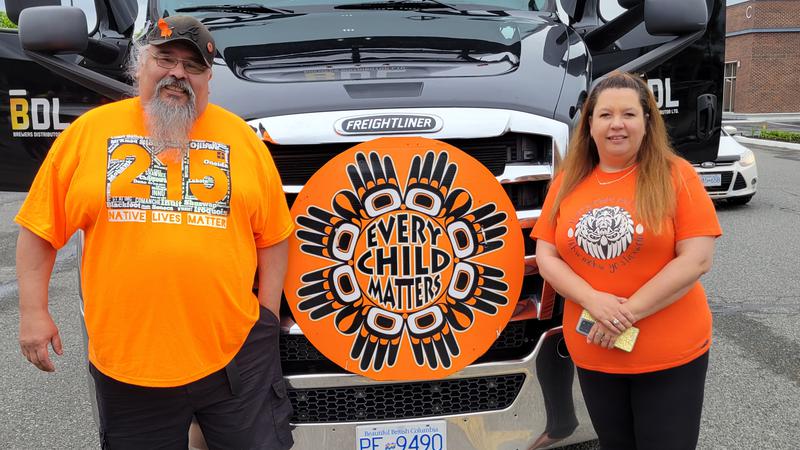
Underscoring the ubiquitous motto that every child matters, Soles, a 22-year resident of Chilliwack, joined forces with the Sikh Riders of Canada motorcycle club and convoys from Lilloett and Kelowna Saturday in the second annual “We Stand in Solidarity Run” to remember victims of residential schools.

A convoy of trucks and motorcycles gathered in front of Chilliwack Mall Saturday morning before traveling 258 kilometers to the former Kamloops Indian Residential School, where the First Nations band there detected the remains of 215 Indigenous children a little over a year ago.

At the time of the discovery, Chief David Jimmie, president of the Sto:lo Nations Chief Council, shed light on the trauma endured by victims at these same schools. “The reprehensible actions of the residential school system have always been deeply felt within our Indigenous communities. Now the rest of the country is beginning to understand just how severely the atrocities committed through residential schools have engrained themselves in our people and the lasting impacts that they have left behind.”

For Soles, who is from T’it’qet First Nations (Tlee-tl-cut) near Lilloett, this trip marked her first time ever visiting the site where her father Gaylord spent several years of his childhood at Kamloops Indian Residential School. A Canadian Broadcasting Corporation film from 1962 (https://www.cbc.ca/player/play/1940976195892) shows a young boy leaning his head out of a second-story window throwing a paper airplane. That young boy was her dad, as shown in the 21st minute of the documentary.

“When I first saw the video, I was blown away,” Soles said. “I had to keep my cool as I was with my dad when I watched it. I know he hurts but he keeps his wall up when it comes to showing any emotions. My dad doesn’t talk too much about it and we don’t ask him. He went through a lot there. He did go there once years ago when he was older and said he was in the stairwell. It smelled the same and looked the same. He said he remembers a little girl was thrown down those stairs.”

Soles was hesitant to visit the site, but once she arrived on scene Saturday, a flood of emotion overwhelmed her thinking of what her dad endured.

“I cried when I arrived,” she said. “I was nervous and anxious as I have not stepped foot on the grounds before. I couldn’t, especially knowing some bits of what happened there.”

Approximately 150,000 First Nations, Inuit and Metis children were forced to attend the government-sponsored residential schools from the 19th century until 1996, when the last school closed its doors. Children lived in substandard conditions and were subject to sexual, physical, and emotional abuse.

“Raising awareness is key,” Soles said. “This needs to be talked about. There needs to be accountability and action taken so the children can be rested and our people can heal.”

Soles believes the government can take meaningful action to ensure reconciliation with First Nations people is achieved, so that convoys like Saturday’s aren’t in vain.

“I think that it’s time to take the steps towards healing, for the government to step right up to this and do what it takes to help with the investigations of the children that were buried in unmarked graves,” Soles said.