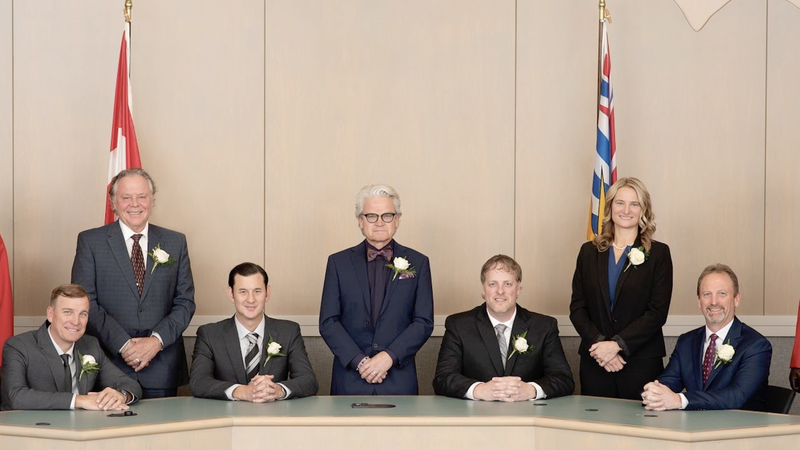
Image: City of Chilliwack / Chilliwack city council is pictured. Councillors Chris Kloot and Bud Mercer, and Mayor Ken Popove came out against the BC government's drug decriminalization during its meeting on Tuesday, July 18, saying the province's approach has not worked, lacked essential components, and was flawed. A city staff member says the City of Chilliwack will advocate, in consultation with the province, for a ban on open drug use in parks and public spaces where children and adults participate in recreational activities, at bus shelters, within 6 metres of windows and entrances to businesses, and within all city facilities. 
Drug decriminalization in BC

Chilliwack city council says drug decriminalization in BC hasn’t worked

Jul 19, 2023 | 10:11 AM

CHILLIWACK — Chilliwack Councillor Chris Kloot minced no words during a presentation by a Chilliwack staff member on drug decriminalization in BC and how the city will respond to the province’s ongoing efforts to clamp down on illicit drug use in public spaces.

Caitlin Weston, manager of bylaw enforcement for the City of Chilliwack, delivered brief remarks surrounding illicit drug consumption in public places to city councillors during their regular meeting on Tuesday afternoon, July 18. She told council members that although drug decriminalization took effect on January 31, 2023, the province is now looking to consult with local governments about banning drug use in certain public places.

“The Province has now acknowledged [a] need to regulate controlled substances in public spaces and is seeking a unified, province-wide approach which will replace local bylaws [this fall],” Weston said. “The province is currently consulting with local governments and has asked that a feedback questionnaire be completed and submitted to them. The province has further requested at this time that municipalities put on hold any bylaw or bylaw amendments that were being considered while they undertake this work.”

Weston said the city of Chilliwack would like a ban on drug use in specific areas.

“We are suggesting that drug use should not be permitted in parks and public spaces where children and adults participate in recreational activities, at bus shelters, within 6 metres of windows and entrances to businesses, and within all city facilities,” Weston said during her presentation. “Staff are advocating for these restrictions with respect to all methods of consumption in order to preserve public safety and enjoyment of use for the general public.”

Councillor Chris Kloot said it was entirely irresponsible and unacceptable to have drug consumption in public spaces like parks.

“The idea that our parks have now become permitted places for open drug use just defies all logic,” Kloot said in a statement shared with Fraser Valley Today. “Playgrounds with children and toddlers do not mix with drugs. I predict in time, British Columbians will see this was a costly experiment by this provincial government. Holding communities hostage by giving up safe park spaces will benefit no one. The province needs to take a step back, re-evaluate, and recognize this is a plague that they are imposing upon the people of our communities, and focus on the real issues at hand, the lack of a recovery-oriented system of care.”

Kloot said he agreed with many other communities across BC who had called on the province to do a better job concerning open drug consumption in public spaces.

“I am fully on board with many other communities across this province calling on the province to do better. It starts with consultation with local government partners,” Kloot said. “Imposing a blanket regulation with next to no consultation shows total incompetence. Enough is enough. We need to stand up as a city, along with many others, and call on the provincial government to stop bringing forward regulations that have harmful impacts on the majority of our residents.”

Drug decriminalization went into effect on January 31 and allowed small amounts of illicit drugs, thereby permitting public consumption in public spaces.

Councillor Bud Mercer, a retired RCMP member, said BC’s rollout of drug decriminalization was flawed from the get-go. He recalled how Kelowna mayor Tom Dyas recently spoke eloquently about the shortfalls associated with drug decriminalization in BC and how a country like Portugal had everything in place before it adopted its decriminalization approach in 2000.

“One of the kind of starship examples [of decriminalization] was Portgual, but he (Mayor Dyas) was quick to point out that before they did it, they had all the mental health facilities in place, all the addiction facilities in place, they had a safe drug supply, they had all the people staffed across the country to fill everything before they pulled the trigger on what we did in the province, and our province had absolutely none of that done,” Mercer said.

Mayor Ken Popove said the police chief of the Delta Police Department came out against drug decriminalization recently because it hasn’t accomplished what it set out to do.

“I heard as early as this morning that there was a police chief to the west of us that voiced his opinion about decriminalization, about a certain amount of drugs on a person,” Popove said. “It was supposed to lower the death rate [of overdoses]. It hasn’t done that either. It’s gonna be a challenge.”