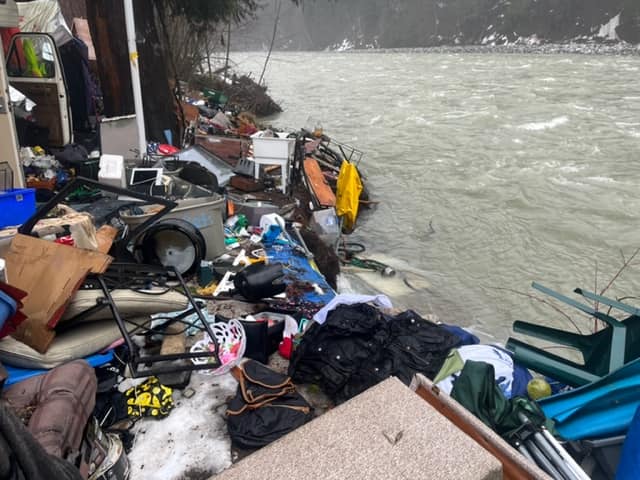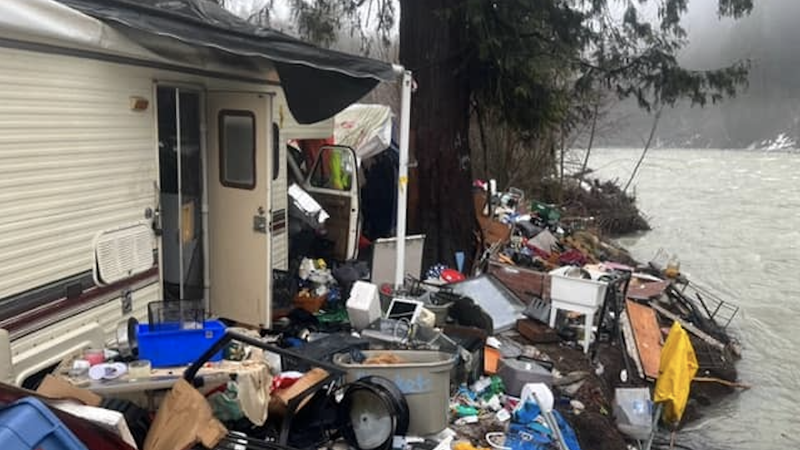
Image: Supplied by Wayne Furness, provided by Ross Aikenhead / An abandoned homeless encampment is pictured on the north side of Chilliwack Lake Road near Allison Pool, in the Chilliwack River Valley. A homeless encampment cleanup volunteer says funding for dump passes to transport garbage from messes like this has suddenly dried up, meaning that volunteers have to pay to dump this garbage at their own expenses.
Chilliwack cleanup volunteer

Chilliwack homeless encampment cleanup volunteer frustrated over no funding for dump passes

Feb 10, 2023 | 8:59 AM

CHILLIWACK — Chilliwack resident Ross Aikenhead has devoted at least six years of his life to cleaning up parts of the Chilliwack River Valley and broad swaths of mountainous backcountry terrain surrounding Chilliwack.

Since January 2019, the amount of debris removed from cleanups he has arranged now exceeds 24,000 kilograms, or 53,000 pounds of garbage.

Up to this point, he’s usually been able to acquire dump passes, courtesy of the City of Chilliwack or Fraser Valley Regional District, to bring garbage from cleanup days and homeless encampments in the Chilliwack River Valley and elsewhere to the Bailey Landfill.

Until now.

Aikenhead, a straight-talking volunteer who minces no words about the environmental impact of garbage and other toxic debris emanating from homeless encampments, said this past week that there is no funding currently available for dump passes to clean up the Chilliwack River Valley, meaning people who want to transport garbage to the landfill are left footing the bill.

“There has been a glitch in the matrix and currently there is no funding available for dump passes in the CRV (Chilliwack River Valley),” Aikenhead wrote on Facebook. “Yesterday I totaled up the cleanups I’ve arranged since January 2019 and the amount of debris removed has been 24,040 kilograms, or 53,000 pounds. That works out to roughly $600 per year in disposal costs and I’m not willing to add any additional costs that I’m not already covering, [like] equipment, fuel, time, maintenance, insurance, and miscellaneous expenses like garbage bags, etc.”

He specifically referenced the cleanup of an abandoned homeless encampment containing a motorhome, RV, and trailer on the north side of Chilliwack Lake Road near Allison Pool.

Image: Supplied by Wayne Furness / A former homeless encampment along the Chilliwack River is pictured from late December 2022.

That encampment removal was supposed to be paid for by the provincial government, Aikenhead said. Instead, it got charged to the Fraser Valley Regional District.

“The cleanup of the motorhome by Allison Pool was supposed to be paid for by the provincial government and it got charged back to the FVRD using the entire year’s budget,” Aikenhead clarified.

Aikenhead said he’s not pointing fingers at FVRD, for the problem is much bigger than the regional district.

“I do not blame, nor am I upset with anyone in the FVRD as the problem comes from further up the government ladder,” he said. “The current problem came from the cleanup of a camp on December 29 that never should have been allowed to happen in the first place. The FVRD does not any authority to evict people from Crown land within their own jurisdictions, just like the City of Chilliwack has no authority over Crown land within city limits.”

Ultimately the Ministry of Forests, Lands, and Natural Resources Operations is responsible for evicting squatters at homeless encampments on Crown lands, not FVRD, RCMP, or the federal government.

“The trails all seem to lead to a certain Ministry but I’m not going to name anyone at this point,” Aikenhead said. “There are people trying to resolve the funding issue and so am I, but until that has been done I will not be arranging any cleanups in the CRV. The Sweltzer Creek camp is just outside of the CRV and I’m still keeping an eye on it. If the two people still in the camp do get housing, we can finish removing the remaining garbage from the river bed.”

Aikenhead added that he did not make arrangements for the Allison Pool homeless encampment along Chilliwack Lake Road, but says the camp never should have been allowed to grow to what it did.