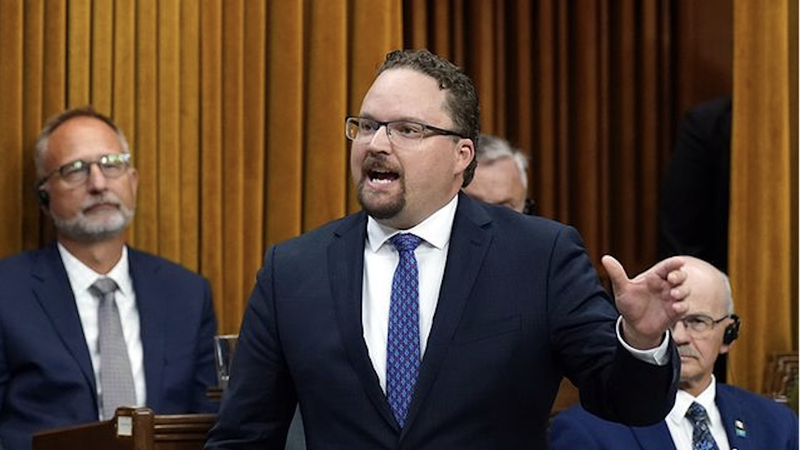
Image: Supplied by the House of Commons / Chilliwack-Hope MP Mark Strahl is citing a letter signed by the Chilliwack Society for Community Living, and 50 other organizations, as validation of his continued opposition to a further expansion of medically assisted death for those suffering from mental health disorders and mental illness.
Medical Assistance in Dying

MP Strahl cites Society for Community Living in opposing expansion of state-assisted dying

Jan 6, 2023 | 10:24 AM

CHILLIWACK — Chilliwack-Hope MP Mark Strahl hasn’t given up in his push to vehemently oppose a further expansion of medical assistance in dying (MAiD) to include those suffering from mental illness.

In a tweet on Thursday (Jan. 5), Strahl continues to push back against widening the criteria by which those with mental illness can seek medically assisted death.

“Disability and human rights organizations across Canada, including the #Chilliwack Society for Community Living in our community, have signed this letter opposing the Liberal government’s proposed expansion of Medical Assistance in Dying,” Strahl wrote.

In the December 23rd letter signed by a coalition of over 50 organizations, including the Chilliwack Society for Community Living, and addressed to Justice Minister David Lametti, the organizations call for the government to pause its determined crusade to expand MAiD.

“We, the undersigned disability and human rights organizations, are writing to express our concern and opposition to the legalization of Medical Assistance in Dying (MAiD) for mental illness and to the already-legal practice of euthanizing people with disabilities who are not terminally ill,” the letter stated, which was also signed by Inclusion B.C., B.C. Complex Kids Society, and B.C. Poverty Reduction Coalition.

The letter goes on to call the legalization of MAiD for those suffering from mental illness “discriminatory” and says expanding MAiD would “pour gas on a fire that is already out of control.”

Over two million Canadians over the age of 15 have a mental-health related disability, the coalition argues, of which the majority are women, non-binary, and other gender non-confirming people.

“As a country we cannot provide state-assisted death to people who are not terminally ill, without ensuring a right to a decent life for all,” the letter stated. “The current MAiD law has chipped away at the constitutional protections of Canadians. The very existence of the current law is a threat to the lives of people with disabilities and their families. The government’s ill-considered, trial-and-error experiment on the lives of persons with disabilities is failing. It is time to ensure protection for all, including people with disabilities.”

According to a report from the Canadian Press, a person must have a serious and incurable illness, disease or disability in an advanced state of irreversible decline in order to receive a medically assisted death. Per federal guidelines, the person has to be enduring intolerable pain or psychological suffering.

Patients whose natural death is not “reasonably foreseeable” must be informed of what options are available to them, including counselling, mental health or disability supports, community services and palliative care. Patients are also required to consult and discuss other potential treatments with their medical practitioner.

They also must be at least 18 years old, have decision-making capacity and make the request voluntary, without external pressure.

Who will be eligible when the program expands?

According to the Canadian Press, people suffering from mental disorders who have other underlying conditions may already be eligible for assisted dying. The expansion specifically includes people who only have a mental disorder.

That will make Canada one of a handful of countries where someone who is suffering from a mental disorder and whose natural death is not foreseeable will be able to receive a medically assisted death.

How does the process work?

First, people have to make a request for medically assisted death in writing and have it signed by an independent witness.

Then, two medical professionals must independently do an assessment and ensure the person is eligible. Consent has to be given throughout the process. If assessors determine a person is eligible, a date of death is determined.

If natural death is “reasonably foreseeable,” the patient can proceed when they are ready. If not, then an additional assessment period of at least 90 days generally takes place. An assisted death can be administered by heath-care professionals or self-administered under their supervision.

How many people have chosen a medically assisted death?

More than 31,000 people chose an assisted death in the first five years after it became legal.

That includes just over 10,000 people in 2021, a 32.4 per cent increase from the year before.

Medically assisted deaths accounted for 3.3 per cent of all deaths in Canada in 2021.