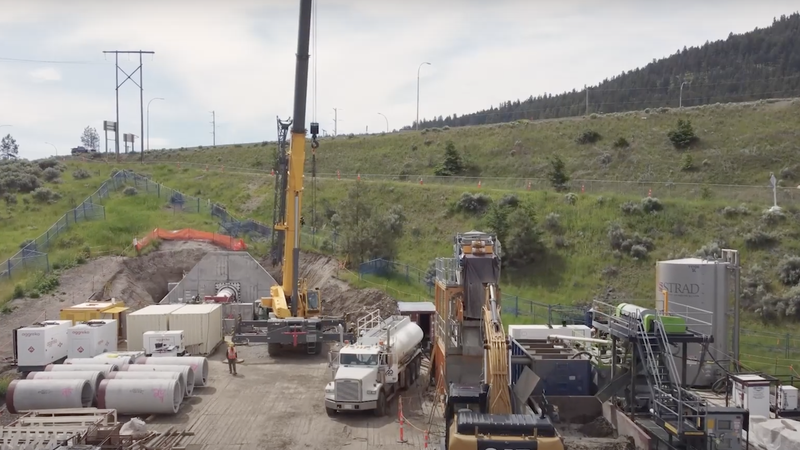
Image: Trans Mountain Corporation website / Trans Mountain Corporation announced Friday (Mar. 10) that completion of the pipeline is nearing 80 per cent completion, as project costs now exceed $30 billion. There are widespread pipeline construction activities happening throughout Chilliwack, east of Chilliwack along Highway 1, and west of Chilliwack.
Trans Mountain pipeline

Trans Mountain pipeline construction nearing 80% completion

Mar 11, 2023 | 9:12 AM

CHILLIWACK — As pipeline activities occur throughout Chilliwack and the surrounding communities to the east and west, Trans Mountain Corporation said Friday that construction of the pipeline is close to 80 per cent complete as project costs now exceed $30 billion.

In a news release posted on its website Friday (Mar. 10), Trans Mountain Corporation says the pipeline will be in service in the first quarter of 2024. Once completed, the pipeline system will have nearly tripled its capacity, representing an increase of 590,000 barrels per day to a total of 890,000 barrels per day.

The company says the expanded pipeline represents an integral piece of Canada’s energy infrastructure, providing an essential route to west coast tidewater for direct access to international markets, including the U.S. and Asia. This access will achieve global market pricing for Canadian crude oil, which is periodically sold at a discount, while supporting Canada’s energy security goals.

Trans Mountain says it is in the process of acquiring external financing to fund the remaining cost of the project, now that the total project cost is estimated at $30.9 billion.

The project capacity is primarily committed to 11 shippers representing a mix of Canadian and international producers and refiners who are contracted for 80 per cent of the available capacity under long-term, take-or-pay transportation contracts for 15 and 20 years. The remaining 20 per cent of the capacity on the expanded system will be available through market mechanisms, the company indicated in its news release.

Estimated costs are attributed to several factors including Trans Mountain’s commitment to ensuring project and community safety, protection of culturally significant sites for Indigenous peoples, environmental preservation, and completing a quality long-term pipeline. Specific factors for cost increases include high global inflation and global supply chain challenges; unprecedented floods in British Columbia; unexpected major archaeological discoveries; challenging terrain between Merritt and Hope; earthquake standards in the Burnaby Mountain tunnel; unexpected water disposal costs in the Sumas Prairie; and issues regarding densely populated areas between Sumas and Burnaby.

“Canada has among the world’s highest standards for the protection of people, the environment, and Indigenous participation when building major infrastructure projects. By including these commitments into the Project design and development from the beginning, we have ensured the Project will provide economic benefits to Canadians well into the future,” said Dawn Farrell, President and CEO of Trans Mountain Corporation.

Trans Mountain says it secured 69 benefit agreements representing 81 Indigenous communities in conjunction with the pipeline expansion.

An independent economic impact assessment for the Project was conducted by Ernst & Young LLP (EY) in March 2023. The assessment stated that during construction between 2018-2023, the Project is estimated to contribute $52.8 billion in gross output, $26.3 billion in gross domestic product (GDP), including $11 billion in wages and more than 67,423 full-time equivalents (FTEs), and $2.9 billion in tax revenue. After completion, EY expects that Trans Mountain’s expanded operations will contribute $17.3 billion in gross output, $9.2 billion in GDP, including $3.7 billion in wages and more than 36,066 FTEs, and $2.8 billion in tax revenue over the next 20 years.

Trans Mountain has generated more than $4.8 billion in contracts with Indigenous businesses, which is 25 per cent of total contracts awarded to date, and has employed over 3,000 Indigenous workers.

“I am particularly proud that throughout development and construction, Trans Mountain has maintained unprecedented levels of Indigenous collaboration and partnership. Over 140 Indigenous groups have been engaged to ensure we protect the land, the water, the wildlife, and significant archaeological sites. Trans Mountain has gone far beyond simple engagement by creating economic partners for generations to come,” continued Farrell.