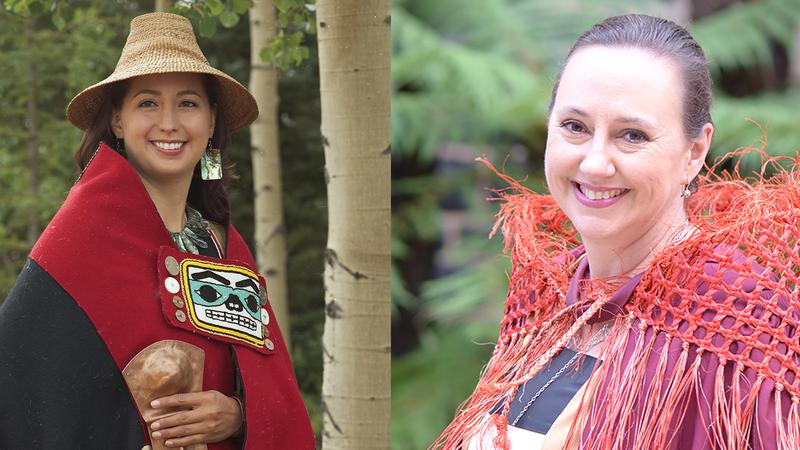
Image: Supplied by UFV / Dr. Mique’l Dangeli (left) and Dr. Keziah Wallis (right) will teach the first-ever Indigenous Film course at UFV this fall on the Abbotsford campus
UFV Indigenous course

Inaugural course in Indigenous film at UFV seeks to dispel First Nations stereotypes

Aug 21, 2022 | 7:00 AM

CHILLIWACK — At a time when truth and reconciliation with First Nations communities is top of mind for many throughout British Columbia, a film course offered at the University of the Fraser Valley hopes to dispel stereotypes associated with Indigenous communities.

According to a press release issued Friday (Aug. 19) by UFV, an idea and opportunity for collaboration among two faculty has led to UFV offering its first ever Indigenous Film course (FILM 313) starting this fall.

Dr. Mique’l Dangeli and Dr. Keziah Wallis, both relatively new faculty members at UFV, immediately bonded over their shared passion for Indigenous cinema while simultaneously appreciating each other’s unique career backgrounds: Dangeli, the talented Tsimshian Nation (Metlakatla, Alaska) dancer, educator and activist for Indigenous sovereignty and decolonization; Wallis, a Māori anthropologist with whakapapa links to the Kāi Tahu iwi of the South Island of New Zealand.

While their similarities united them, their differences brought them to a mutual recognition they could compliment each other in a classroom setting.

“We started discussing how valuable an Indigenous film class would be for aspiring Indigenous filmmakers as well as just curious students wanting to expand their horizons,” says Wallis, an assistant professor in the School of Culture, Media, and Society (SCMS) since 2019. “And about the same time, the call came out for co-teaching.”

In the following weeks, the pair submitted a proposal that was supported by the directors of both of their schools and approved by the UFV College of Arts. Dangeli has been an assistant professor in the School of Creative Arts since January.

To date, there are nearly 20 students registered for the course with a few slots available (sign up here).

“Beyond excited to be teaching this course of Indigenous Film with my amazing Tsimshian friend & colleague in the Fall,” Wallis posted on Twitter in May. “Now if only we can stop geeking out about films enough to put together a syllabus…”

Since the course approval, Wallis and Dangeli have been discussing how they will share teaching duties as well as paring down the list of Indigenous films that the class will review, analyze and discuss. They envision students discovering the powerful ways that Indigenous cinema provides insights into decolonization processes, self-determination, activism, place-based knowledge, sovereignty, and more.

They are also hoping the course, which will be taught on the Abbotsford campus, will dispel stereotypes of how Indigenous peoples are portrayed in mainstream movies or pop culture.

“There are not many Indigenous characters on television or film, so any representation carries so much weight,” says Wallis. “What you often find is the characters are very two-dimensional that often conform to very narrow stereotypes, like the brave warrior or the maiden.”

Students will be introduced to movies and documentaries created by Indigenous filmmakers, with characters and subjects that possess greater depth.

“We can be university professors, we can be marketers,” says Wallis. “We can be characters that are current and alive, we don’t have to be located in the past.”

There will be Indigenous films in multiple genres (comedies, horror, musicals, documentaries) from multiple countries, including at least one by a local Stó:lō filmmaker. Wallis isn’t keen to disclose just yet the movies the class will review, nor will she reveal the growing list of guest speakers — which includes prominent Indigenous filmmakers.

“We have a very, very exciting list of guest speakers,” Wallis promises. “When Mique’l started mentioning names of people who were interested in coming and speaking, I was like, ‘Oh my goodness, that’s one of my favourite directors.’”

Dangeli’s people, the Tsimshian, are Indigenous to Northern British Columbia and Southeast Alaska. She grew up in Metlakatla, the only Indian reserve in Alaska, and has spent most of her adult life attending and working at universities in B.C.

Wallis has experience living as an Indigenous person on other Indigenous lands growing up in both Australia and New Zealand. While she moved to Abbotsford only three years ago, Wallis is still acclimating herself with Indigenous culture in Canada and recognizes both the similarities and differences of her Indigenous roots.

Since discussion about reconciliation is at the forefront of the public arena these days, Dangeli and Wallis acknowledge the tremendous responsibility this new course brings. However, the professors hope the experience is a fun one for students.

“I hope that students walk away from it with, if not a new appreciation, a renewed appreciation, a deeper understanding of the complexity of Indigenous culture and the arts,” Wallis says. “Maybe, you will look at representation differently. Maybe, you’ll appreciate the dialogues in different ways.

“Indigenous film has all of these layers and I also hope the students walk away from it saying, ‘wow, I learned a lot.’”