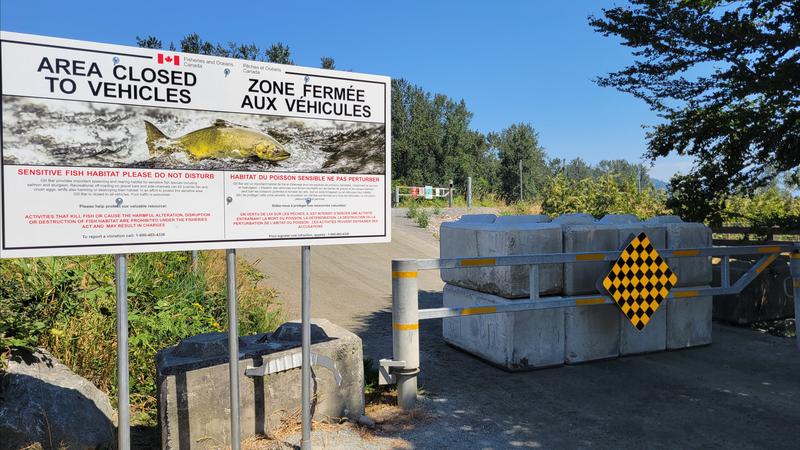
Image: M. Vanden Bosch / PML / The federal government has erected roadblocks and a locked gate to thwart the further destruction of critical fish habitat at Gill Bar in Chilliwack.
Gill Bar

Federal government erects roadblocks, locked gate to stop further destruction of sensitive fish habitat at Gill Bar

Jul 28, 2022 | 1:45 PM

CHILLIWACK — The days of reckless revelers and partying at the end of Gill Road and impacting the surrounding area, not to mention motorbikes and quad activities, appear to be numbered, at least for the time being.

The federal government erected roadblocks and a locked road gate preventing motorized access to portions of Gill Bar, Fisheries and Oceans Canada (DFO) said in a Thursday statement.

Public access to Gill Bar via foot traffic or small boat will remain unaffected. However, the roadblocks and locked gate will remain in place until the long-term management planning process currently underway concludes.

For years, Gill Bar and its gravel bar and side channels have been a popular destination offering a range of recreational opportunities consisting of camping, motorbikes, and four-wheel adventures, just to name a few.

But according to DFO, Gill Bar and side channels also have important ecological and fish habitat value to Chilliwack-area First Nations, and are an ongoing concern for conservation and stewardship groups in the Fraser Valley. Public use throughout the year has historically raised concerns around damage to the bar and salmon habitat.

During the COVID-19 pandemic, DFO says there’s been a surge of activity in the area, including off-road trucks driving through the gravel side channels. Unfortunately, enforcement and various measures like public education, media outreach, coordination with off-road organizations and investigations into possible illegal activities, have not produced optimal results in protecting the area’s sensitive habitat.

A resident of Gill Road who spoke to Fraser Valley Today Thursday and wished to remain anonymous said she and her family have repeatedly heard and witnessed burnouts on the narrow country road, loud trucks, fireworks from October onward, and heard illegal gunshots fired at trees in the area. She welcomed the roadblocks and gate because people have wandered onto her property not far from Gill Bar. On a few occasions, stragglers have entered their dairy barn without permission, even to the point one woman tried to pet a cow by entering a dairy stall.

“There have been big parties at the river and drunks doing burnouts on the road,” the Gill Road resident said. “I’m sure there’s been an environmental impact. It’ll be better [with this]. They’ve left behind garbage. A select few people ruin it for the rest. We’ve had ambulances and fire engines respond. I’ve seen oil or gas mixing with sitting water near the river. These trucks keep pushing further into salmon beds and destroying amphibious beds.”

Which is exactly what DFO cited in its statement. For example, DFO pinpoints Gill Bar as the “heart of the Fraser,” a critical stretch of the Fraser River between Hope and Mission, where numerous fish species inhabit the area, including all five Pacific salmon species. Side channels adjacent to the bar represent a critical spawning habitat for salmon as well as white sturgeon, which have been assessed as threatened by the Committee on the Status of Endangered Wildlife in Canada. White sturgeon are currently under consideration for listing under the Species at Risk Act.

The side channels also support rearing juvenile salmon, including Chinook stocks emigrating from upstream areas of the Fraser River such as the Bridge, Nechako, Stuart and South Thompson Rivers, and are an important habitat for eulachon, a culturally significant species to B.C. First Nations.